
Your store is getting orders, the inbox is filling up, and suddenly your evenings are spent printing labels and taping boxes at the kitchen table. That moment — where selling outpaces your ability to ship — is exactly when understanding fulfillment stops being optional. So what is eCommerce fulfillment, really? It's the entire operation that happens after a customer clicks "buy": storing your products, picking and packing each order, shipping it, and handling any returns. This guide breaks down how the order fulfillment process actually works, the three models you can choose from, what it costs, and the signals that tell you it's time to hand it off. By the end, you'll know exactly which approach fits your store today — and what to look for when you outgrow it.
What Is eCommerce Fulfillment?
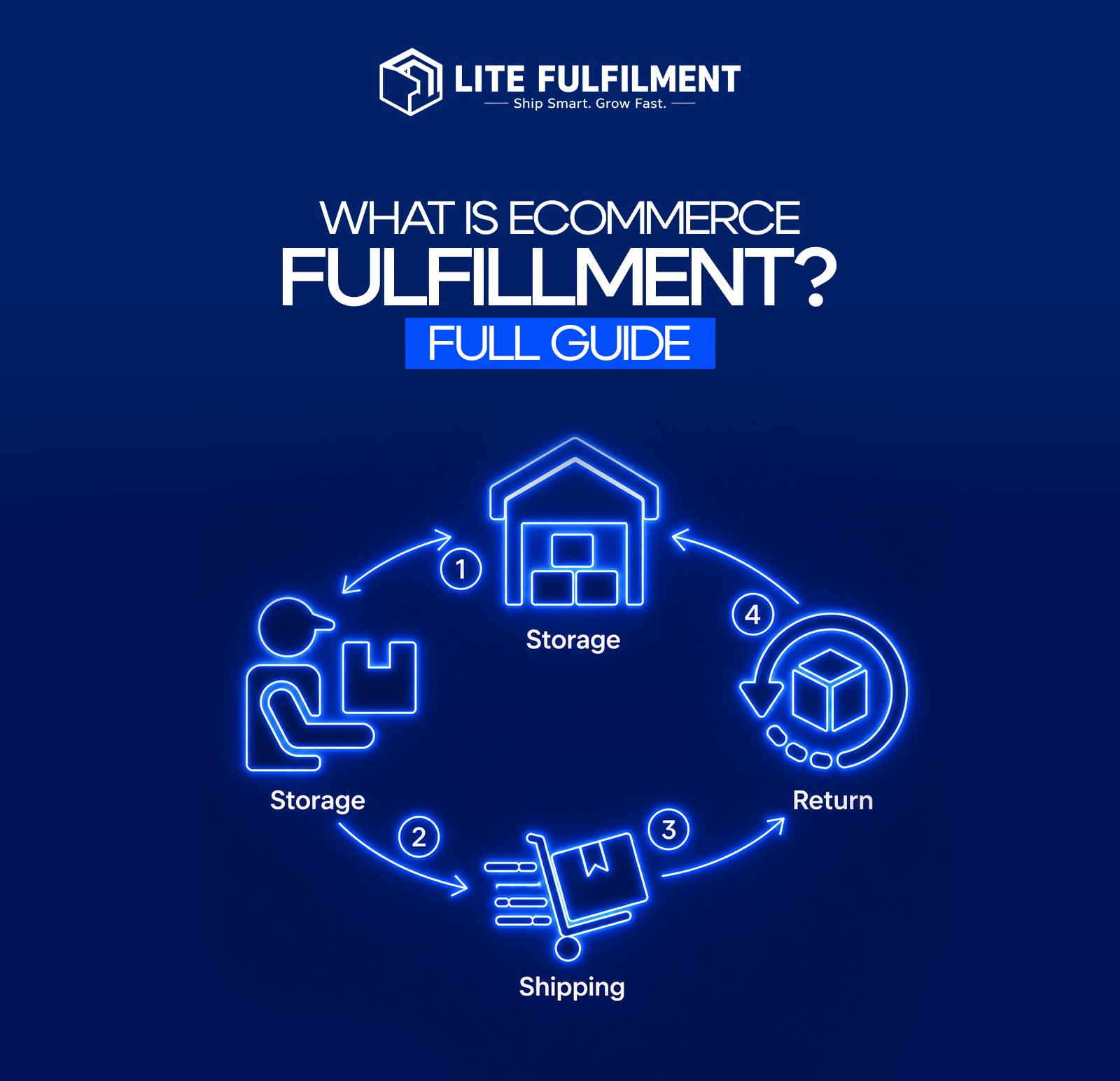
eCommerce fulfillment is the complete process of getting an online order from your inventory to the customer's door. It covers five core stages: receiving inventory, storing it, picking the items for each order, packing them, and shipping — plus the often-overlooked sixth stage of processing returns.
It's easy to assume fulfillment is just "mailing stuff out," but that undersells it. Fulfillment is the operational backbone of an online business. Done well, it's invisible: orders arrive fast, accurate, and intact. Done poorly, it becomes the single biggest source of bad reviews, refund requests, and customers who never come back.
For a growing brand, fulfillment quickly becomes the difference between scaling smoothly and drowning in operational work. That's the point where dedicated ecommerce fulfillment services take the warehouse work off your plate so you can focus on selling.
🔑 Key takeaway: eCommerce fulfillment is not just shipping — it's the entire operational cycle from receiving stock to processing returns. Getting any stage wrong creates problems downstream: wrong items ship, inventory counts go off, and customers leave bad reviews.
Fulfillment vs. Shipping: They Are Not the Same Thing
These two terms get used interchangeably, but conflating them leads to bad decisions. Shipping is one step — the physical transport of a package from A to B. Fulfillment is the whole system that shipping sits inside.
Put simply: a shipping carrier (USPS, UPS, FedEx, DHL) moves the box. Fulfillment is everything that determines what's in the box, whether it's the right item, how fast it goes out the door, and what happens when it comes back. Choosing a great carrier won't save you if your picking is inaccurate or your dispatch is slow — which is why brands that obsess over shipping rates while ignoring fulfillment quality often still end up with unhappy customers.
How the Order Fulfillment Process Works, Step by Step
Here's the actual sequence every order follows inside a fulfillment operation:
Receiving
Inventory arrives at the warehouse, is counted against the expected quantity, and logged into the system.
Storage
Each SKU is shelved in a tracked location so it can be found instantly when ordered.
Order Capture
A sale on Shopify, Amazon, Walmart, WooCommerce, or TikTok Shop syncs automatically into the fulfillment system.
Picking
The exact items for the order are retrieved from their storage locations.
Packing
Items are packed securely, with the right materials for the product and destination.
Shipping
The order is labeled, assigned to the optimal carrier, and dispatched.
Returns
If a customer sends an item back, it's inspected, restocked or disposed of, and the customer is processed.
💡 Pro tip: The two stages brands underestimate most are receiving and returns. Sloppy receiving means inaccurate stock counts and overselling; weak returns handling means lost inventory and frustrated customers. A real fulfillment operation treats all seven stages as equally important — not just the "ship it" moment.
The Three Fulfillment Models: In-House, Dropshipping, and 3PL
Every online brand uses one of three approaches. Understanding the trade-offs is the foundation of every fulfillment decision you'll make.
- In-house fulfillment. You store, pack, and ship orders yourself, from home or your own warehouse. Maximum control, lowest cost at tiny volume — but it stops scaling fast.
- Dropshipping. Your supplier ships directly to the customer; you never touch the inventory. Low upfront cost, but thin margins and no control over packaging, speed, or quality.
- Outsourced 3PL (third-party logistics). A specialist partner stores your inventory and handles picking, packing, shipping, and returns. You trade some control for scale, speed, and freed-up time.
Most brands start in-house, and many graduate to a 3PL as they grow. If you want the deeper trade-off analysis, we cover it fully in our guide on 3PL vs in-house fulfillment.
In-House vs. Outsourced Fulfillment: An Honest Comparison
There's no universally "best" model — only the right one for your stage. Here's the honest side-by-side:
| Factor | In-House | Outsourced 3PL |
|---|---|---|
| Upfront cost | Low at small scale | No warehouse setup; pay per use |
| Control | Full | Shared — you set the rules, they execute |
| Scalability | Limited by your space and staff | Scales with volume and peak season |
| Speed | Depends on you | Same-day dispatch, optimized carriers |
| Time cost | High — your hours | Low — freed to focus on growth |
| Best for | Very low volume, custom needs | Growing, multi-channel, or global brands |
The honest rule of thumb: in-house wins when volume is low and every order is special; a 3PL wins the moment fulfillment starts eating the time you should spend growing the business.
What eCommerce Fulfillment Costs (and What Drives It)
There's no single per-order price — cost is built from a predictable set of components. Knowing them lets you compare providers honestly:
| Cost Component | What It Covers |
|---|---|
| Receiving | Unloading, counting, and logging inbound inventory |
| Storage | Space your inventory occupies, by volume and time |
| Pick & pack | Retrieving and packing each order; rises with SKUs per order |
| Packaging | Boxes, mailers, and protective materials |
| Shipping | Carrier cost by weight, dimensions, and destination |
| Returns | Inspection, restocking, and processing |
⚠️ Watch for hidden fees. The headline pick-and-pack rate is only part of the picture. Onboarding fees, long-term contracts, monthly minimums, and surprise surcharges are where costs balloon. Lite Fulfillment works with no long-term contracts and no monthly minimums, and our Delaware hub's 0% state sales tax removes 8–9% that brands typically absorb on inbound inventory elsewhere in the US.
Signs It's Time to Outsource Fulfillment
How do you know you've outgrown doing it yourself? These are the practitioner signals we see most often:
- You're spending more time packing orders than growing the business.
- Order volume spikes (peak season, a viral product) overwhelm your capacity.
- Shipping errors and delays are creeping into your reviews.
- You're selling across multiple channels and can't keep inventory in sync.
- You want to ship faster or internationally but lack the carrier relationships.
- Storage at home or your office has simply run out of room.
If two or more of these sound familiar, the math has usually already tipped. The cost of a 3PL is rarely the real question — the cost of your own time, and of the orders you're mishandling, almost always is.
How to Choose the Right Fulfillment Partner
Once you decide to outsource, vet providers against this checklist before signing anything:
- Platform integrations — does it sync natively with Shopify, Amazon, Walmart, WooCommerce, and TikTok Shop?
- Accuracy data — can the provider cite a real order-accuracy figure?
- Dispatch speed — same-day cutoffs, or does your order wait a day?
- Reach — domestic only, or genuine international and cross-border capability?
- Contract terms — flexible and pay-as-you-go, or locked into minimums?
- Returns handling — is reverse logistics included or an afterthought?
- Transparency — are all fees disclosed upfront, with no hidden surcharges?
If you want to see the full menu of capabilities a modern 3PL should offer — from kitting to international shipping — browse all fulfillment services. The right partner should feel less like a vendor and more like an extension of your operations team.
Frequently Asked Questions
eCommerce fulfillment is everything that happens after a customer places an online order: receiving and storing your inventory, picking and packing the order, shipping it, and handling returns. A fulfillment provider like Lite Fulfillment runs this entire cycle for online brands, processing orders at 99.98% accuracy across 200+ countries.
Shipping is a single step — the physical transport of a package by a carrier like USPS, UPS, or DHL. Fulfillment is the whole system that contains shipping, including receiving inventory, storing it, picking, packing, and processing returns. Good shipping can't fix poor fulfillment if the wrong item ships or if dispatch is slow.
There are three main models. In-house means you store and ship orders yourself. Dropshipping means your supplier ships directly to the customer. Outsourced 3PL means a third-party logistics provider stores your inventory and handles picking, packing, shipping, and returns — the model most brands move to as they scale.
Outsource when fulfillment starts limiting growth: when packing eats time you need for the business, when peak-season volume overwhelms you, when shipping errors hit your reviews, or when you sell across multiple channels and can't sync inventory. If two or more of those apply, a 3PL usually pays for itself.
There's no flat per-order rate. Cost is built from receiving, storage, pick-and-pack, packaging, shipping, and returns. Watch for hidden fees like onboarding charges, monthly minimums, and surcharges. Lite Fulfillment works with no long-term contracts or minimums, and its Delaware hub's 0% sales tax removes 8–9% brands typically absorb on inbound inventory.
Pick and pack is the core of the fulfillment process: "pick" means retrieving the exact items for an order from their storage locations, and "pack" means packaging them securely with the right materials for safe transit. Accuracy at this stage is what separates a 99.98%-accurate operation from one generating constant refund requests.