
Apparel Fulfillment Services Built for Fashion and Clothing Brands
Lite Fulfillment provides apparel fulfillment services for clothing brands that sell online and ship worldwide. We receive your inventory at our warehouse, store garments in conditions that protect fabric quality, pick and pack orders by size and color, and dispatch them the same day they come in. Whether you ship ten orders a week or thousands during a product launch, our warehouse operations are built around the specific demands of fashion and clothing products.
Clothing fulfillment requires handling that general ecommerce warehouses are not set up for. Garments need fabric-appropriate storage, exact variant accuracy on every pick, and packaging that reflects your brand. Our process accounts for each of these requirements, from how we inspect inbound inventory to how we handle sizing exchanges. We work with brands at every stage of growth, with no long-term contracts and no monthly minimums.
How Apparel Fulfillment Differs from Standard Ecommerce Logistics
A standard ecommerce fulfillment center stores products on shelves, picks items by SKU, and ships them in corrugated boxes. That model works for electronics, home goods, and packaged supplements. Apparel introduces complexity at every stage that general warehouses are not designed to handle.
Clothing products multiply SKU counts faster than any other product category. A single style offered in multiple sizes and colors can generate dozens of variants, each requiring its own bin location, inventory count, and quality checkpoint. That density affects warehouse layout, pick path efficiency, and error rates.
Garments also require different handling standards. Fabrics wrinkle, snag, and absorb moisture. Folding methods vary between knits and wovens. Certain items ship on hangers using garment-on-hanger (GOH) preparation rather than folded in poly mailers. These requirements mean a fulfillment partner needs apparel-specific processes, not workarounds applied to a general warehouse setup.
Return rates add another layer. Apparel returns run significantly higher than general ecommerce averages, and most are driven by fit rather than defect. A 3PL built for apparel treats returns processing, garment inspection, and sizing exchanges as core operations rather than exceptions.
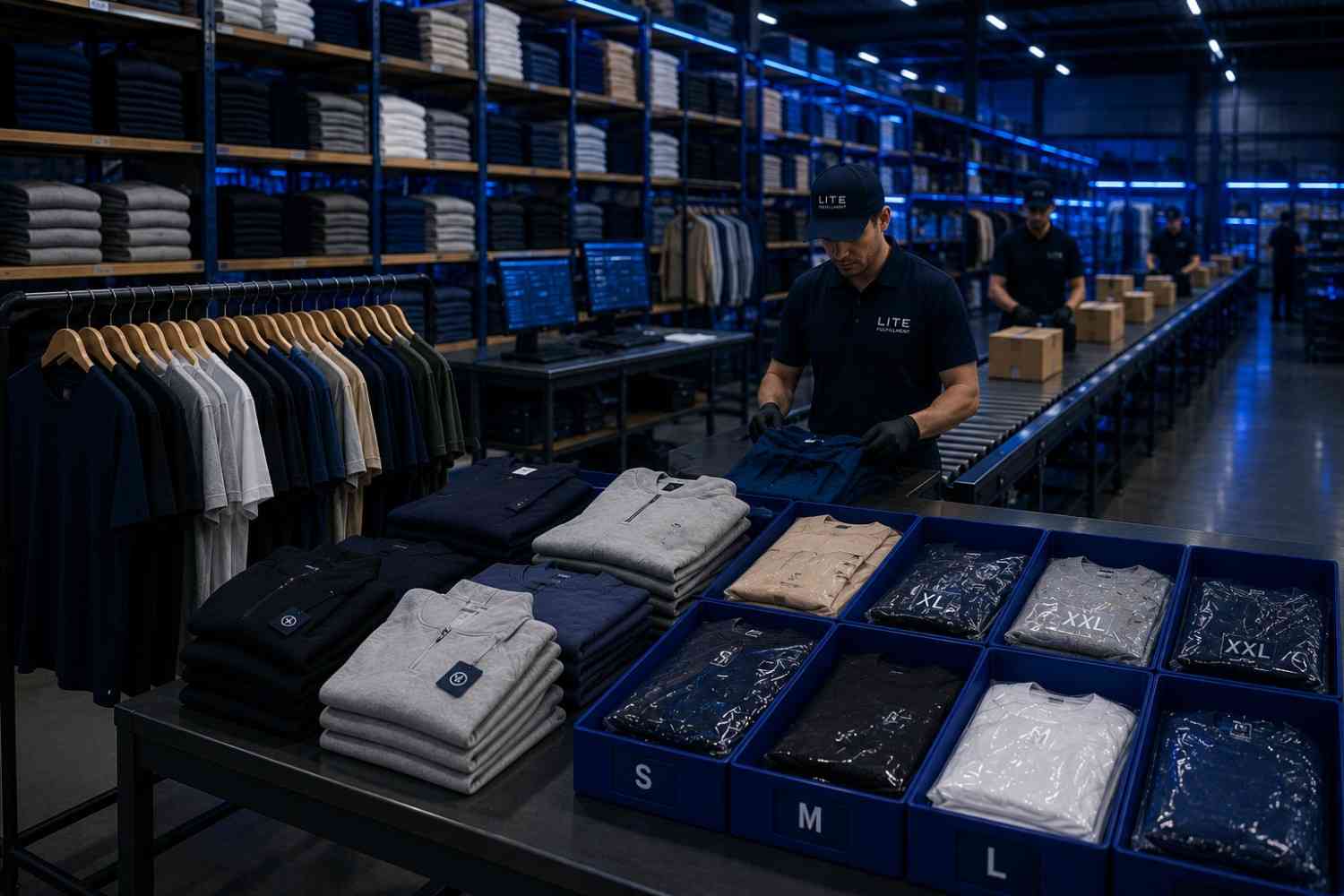
From Receiving to Dispatch: How We Fulfill an Apparel Order
Every garment that enters our warehouse follows a defined process from receiving through dispatch. Here is how an apparel order moves through our facility.
Receiving and Inbound Inspection
Your inventory arrives at our warehouse by freight, parcel, or container shipment. We recommend sending an advance shipment notice (ASN) so our team knows what to expect before the delivery arrives. Cartons should be labeled by style, size, and color to speed intake and reduce sorting time on our end.
Our team counts every unit against the packing list and inspects garments for visible defects, staining, missing tags, and shipping damage. We flag and report discrepancies before shelving a single item. Catching problems at intake prevents fulfillment errors from compounding downstream.
Inventory Storage and Garment Care
Garments are stored in clean, climate-appropriate conditions. Folded items go into bin locations organized by style, size, and color. Hanging garments are placed on rolling racks in designated garment-on-hanger (GOH) zones. We separate delicate fabrics from heavier items to avoid snag damage during warehouse movement.
Every SKU is mapped in our warehouse management system (WMS) so inventory counts stay accurate in real time. When stock levels for a specific size or colorway drop below the reorder threshold you set, the system flags it automatically.
Order Picking by Size and Color
When an order arrives from your sales channel, the WMS assigns it to a picker with the exact bin location for each item. Size and color accuracy is the most critical step in apparel fulfillment. A customer who ordered a medium navy hoodie and receives a large black one will return it, costing you outbound shipping, the return label, inspection time, and potentially the customer.
Our picking process verifies each variant attribute before the item moves to packing. Barcode scanning at the pick point confirms the correct style, size, and colorway against the order. This is where the 99.98% order accuracy rate is built.
Packing and Brand Presentation
Packing apparel goes beyond placing a garment in a shipping container. We fold items according to your specifications, wrap them in tissue paper or poly bags as directed, and include any branded inserts, care cards, or promotional materials you provide.
Packaging options range from standard poly mailers for lightweight items to custom boxes for premium products. Hanging garments ship in garment bags to prevent creasing during transit. Delicate items like silk or embroidered pieces receive additional protective wrapping. We document the exact packaging specs for each product category during onboarding so every order ships consistently.
Same-Day Dispatch and Shipping
Orders received before the daily cutoff ship the same day. We generate shipping labels through rate-optimized carrier selection, choosing the best combination of cost and delivery speed for each destination. Tracking information pushes back to your sales platform automatically so your customer receives shipment updates without manual work on your side.
Managing Sizes, Variants, and High-SKU Apparel Catalogs
Variant complexity is the defining operational challenge of apparel fulfillment. A brand with 20 styles, each available in a full size run from XS to 3XL and four colorways, can carry over 500 active SKUs. Seasonal collections, limited editions, and new colorways push that number higher every quarter.
Our WMS tracks each variant as a distinct SKU with its own bin location, quantity, and reorder threshold. This prevents the most common apparel fulfillment errors: sending the wrong size, shipping the wrong colorway, or overselling a variant that is actually out of stock.
Inventory is organized using size-adjacent slotting, which places all sizes of the same style within arm's reach of the picker. This reduces pick time and lowers the chance of a mis-pick when adjacent sizes sit next to each other. Color variants within each size group are arranged in a consistent sequence so pickers build muscle memory across repeated orders.
For brands with large or rapidly changing catalogs, we support bulk SKU uploads, barcode scanning at every touchpoint, and real-time inventory syncing across connected sales channels. When a size sells out on Shopify, the quantity updates on Amazon and your other channels within minutes.
Garment Care, Packaging, and Brand Presentation Standards
How a garment arrives in the customer's hands reflects directly on your brand. A wrinkled shirt stuffed into an oversized box sends a different message than a neatly folded top wrapped in tissue inside a branded mailer.
We handle garments according to their fabric type and your brand presentation requirements. Standard preparation includes folding, poly-bagging, and labeling. For brands that require elevated packaging, we support tissue wrapping, custom box inserts, branded stickers, thank-you cards, and seasonal promotional materials.
Hanging garments ship in garment bags to prevent creasing. Delicate items receive additional protective wrapping. We work with your team during onboarding to document the exact packaging specifications for each product category, including any retailer-specific requirements for wholesale orders. Every garment ships the way you specified, every time.
Apparel Return Rates, Sizing Exchanges, and Restocking
Apparel return rates typically run between 20% and 30%, well above the roughly 10% average for general ecommerce. Certain categories like formalwear and footwear can run higher. Most returns are driven by fit, and a large portion of those customers want the same product in a different size rather than a refund.
When a returned garment arrives at our warehouse, we inspect it against a standardized checklist: wear signs, damage, staining, odor, missing tags, and original packaging condition. Items that pass inspection are refolded, repackaged if needed, and returned to active inventory. Items that fail are separated and held for your review.
We track the reason for each return and report that data back to your team. Knowing whether returns are driven by sizing inconsistency, fabric expectations, or color discrepancy helps you improve product descriptions, update sizing charts, and reduce return rates over time. This reporting turns a cost center into a feedback loop.
Sizing exchanges are handled as priority orders. The replacement ships as soon as the return is received and inspected, reducing wait time for your customer and increasing the likelihood the sale is retained.
For a deeper look at how we manage the full returns lifecycle, including return label generation, disposition workflows, and refund coordination, visit our returns management services page.
Peak Seasons, Product Drops, and Capacity Planning
Apparel demand is not consistent throughout the year. Holiday shopping, back-to-school buying, and seasonal collection launches create sharp volume spikes that a fulfillment operation must absorb without delays or errors.
November and December typically produce the highest order volumes for clothing brands, while January drops as post-holiday demand cools. Product drops and flash sales create even more concentrated surges, sometimes doubling daily order counts within a 24-hour window.
Preparing for these fluctuations starts well before peak season arrives. We recommend shipping peak-season inventory to our warehouse four to six weeks before your anticipated volume increase. This gives our team time to receive, inspect, count, and slot your products into optimized pick locations before the rush begins.
During peak periods, we adjust staffing levels, pre-position high-velocity inventory near packing stations, and coordinate inbound shipment timing with your production schedule. For brands that launch new collections on a fixed calendar, we support pre-receiving inventory in advance so products are shelved and ready to ship the moment your drop goes live.
What Drives Apparel Fulfillment Costs
Fulfillment pricing for apparel depends on several factors specific to clothing products. Understanding what drives cost and how fees are typically structured helps you evaluate providers and budget accurately.
Most apparel fulfillment pricing breaks down into three fee categories: a per-unit storage fee (billed monthly by bin, shelf, or pallet position), a per-order pick and pack fee (covering labor and standard packaging materials), and shipping costs (passed through at negotiated carrier rates). Additional services like custom packaging, return processing, and kitting carry separate per-unit or per-order charges.
The primary cost drivers within that structure include:
Storage volume: Hanging garments take more cubic space than folded items stored in bins. Seasonal inventory buildup before peak months increases storage charges temporarily.
Variant complexity: Higher SKU counts require more bin locations, longer pick paths, and more detailed quality checks. A 500-SKU catalog costs more to fulfill than a 50-SKU catalog at the same order volume.
Packaging requirements: Standard poly mailers are the lowest-cost option. Custom branded boxes, tissue wrapping, and promotional inserts add per-order material and labor costs.
Return processing: Apparel's higher return rate means more inspection, restocking, and exchange fulfillment labor. Brands with higher return rates carry meaningfully higher per-order costs.
Shipping destination: Domestic shipments within the United States are the most economical. International orders involve additional documentation, customs compliance, and higher carrier rates.
We do not charge long-term contract fees or require monthly order minimums, which gives growing brands the flexibility to scale fulfillment spending in proportion to actual sales.
Shipping Apparel Orders to International Customers
Lite Fulfillment ships apparel orders to more than 200 countries from our warehouse in Delaware. International apparel shipping involves considerations beyond domestic orders, including customs duties, textile classification codes, and country-specific labeling requirements.
Clothing products are classified under specific Harmonized System codes for customs purposes. Accurate classification determines the duty rate your customer or your brand pays, depending on whether you ship DDP (delivered duty paid) or DDU (delivered duty unpaid). We support both models.
Our Delaware location provides a logistical advantage for international shipments. The state has no general sales tax, which reduces landed cost for orders heading overseas. Proximity to major East Coast ports and air freight hubs shortens transit times for shipments to Europe, the Middle East, and West Africa.
For detailed information about our DDP shipping program and international logistics capabilities, visit our international fulfillment and DDP shipping services pages.
Platforms and Sales Channels We Connect To
Your fulfillment partner needs to connect directly with the platforms where you sell. LiteFulfillment integrates with the ecommerce platforms and marketplaces that apparel brands use most:
Shopify and Shopify Plus
Amazon (FBA Prep and FBM)
WooCommerce
TikTok Shop
Etsy
Walmart Marketplace
eBay
Orders from each connected channel flow into our WMS automatically. Inventory levels sync across all channels in real time, preventing overselling when a popular size moves quickly on one platform.
For brands that also sell through wholesale channels or need to meet specific retailer compliance requirements (UPC barcodes, poly-bag specifications, routing guides), we handle those preparation steps as part of the fulfillment workflow. Visit our integrations page for the full list of supported platforms and connection options.
Clothing Categories and Product Types We Fulfill
We fulfill orders across a wide range of apparel categories. Each product type involves different handling, storage, and packaging requirements, and our warehouse processes accommodate those differences.
| Category | Storage Method | Packaging |
|---|---|---|
| Casual wear and basics | Folded in bins | Poly mailer or branded mailer |
| Activewear and athleisure | Folded in bins | Poly mailer |
| Streetwear and urban fashion | Folded or hanging | Custom branded box |
| Swimwear | Folded in bins | Poly bag with branded insert |
| Luxury and designer apparel | Hanging on racks (GOH) | Tissue-wrapped in custom box |
| Corporate and workwear | Folded in bins | Standard corrugated box |
| Footwear | Boxed on shelves | Shoe box inside shipping box |
| Accessories (hats, belts, scarves) | Bin or hook storage | Poly mailer or small box |
| Subscription boxes | Kitting area | Custom branded box with inserts |
This is not a complete list. If your brand sells a clothing product type not shown here, contact our team to confirm we can handle your specific requirements.
How Onboarding Works
Getting started with a new fulfillment partner involves setup work on both sides. Here is what the onboarding process looks like when you move your apparel inventory to Lite Fulfillment.
We begin with a catalog review to understand your product line, variant structure, packaging requirements, and sales channel connections. Your team provides your SKU list, product dimensions, and any brand-specific packing instructions. We set up your catalog in our WMS and configure the integrations for your sales platforms.
Once your catalog is configured and integrations are connected, we receive your full inventory and begin fulfilling live orders. Most brands complete the onboarding process and start shipping within a few weeks, depending on catalog complexity and inventory timing.
Frequently Asked Questions About Apparel Fulfillment
Get a QuoteApparel fulfillment involves higher SKU counts from size and color variants, specific garment handling and storage requirements, branded packaging expectations, and return rates well above general ecommerce averages. A fulfillment center built for apparel manages these factors as standard operations rather than exceptions.
When a customer returns an item for a different size, we inspect the returned garment, confirm it meets resale condition, and ship the replacement size as a priority order. We also track the reason for the exchange and include that data in your returns reporting.
Yes. We ship apparel to more than 200 countries from our Delaware warehouse. We support both DDP (delivered duty paid) and DDU (delivered duty unpaid) shipping methods and handle the textile-specific customs documentation required for international clothing shipments.
We integrate with Shopify, Amazon, WooCommerce, TikTok Shop, Etsy, Walmart Marketplace, eBay, and additional platforms. Orders sync automatically and inventory updates across all connected channels in real time.
No. Lite Fulfillment does not require long-term contracts or monthly order minimums. You can start fulfilling orders and scale at your own pace without being locked into volume commitments.
Onboarding timelines depend on catalog size, variant complexity, and how quickly inventory can be shipped to our warehouse. Most brands complete setup and begin shipping live orders within a few weeks.