
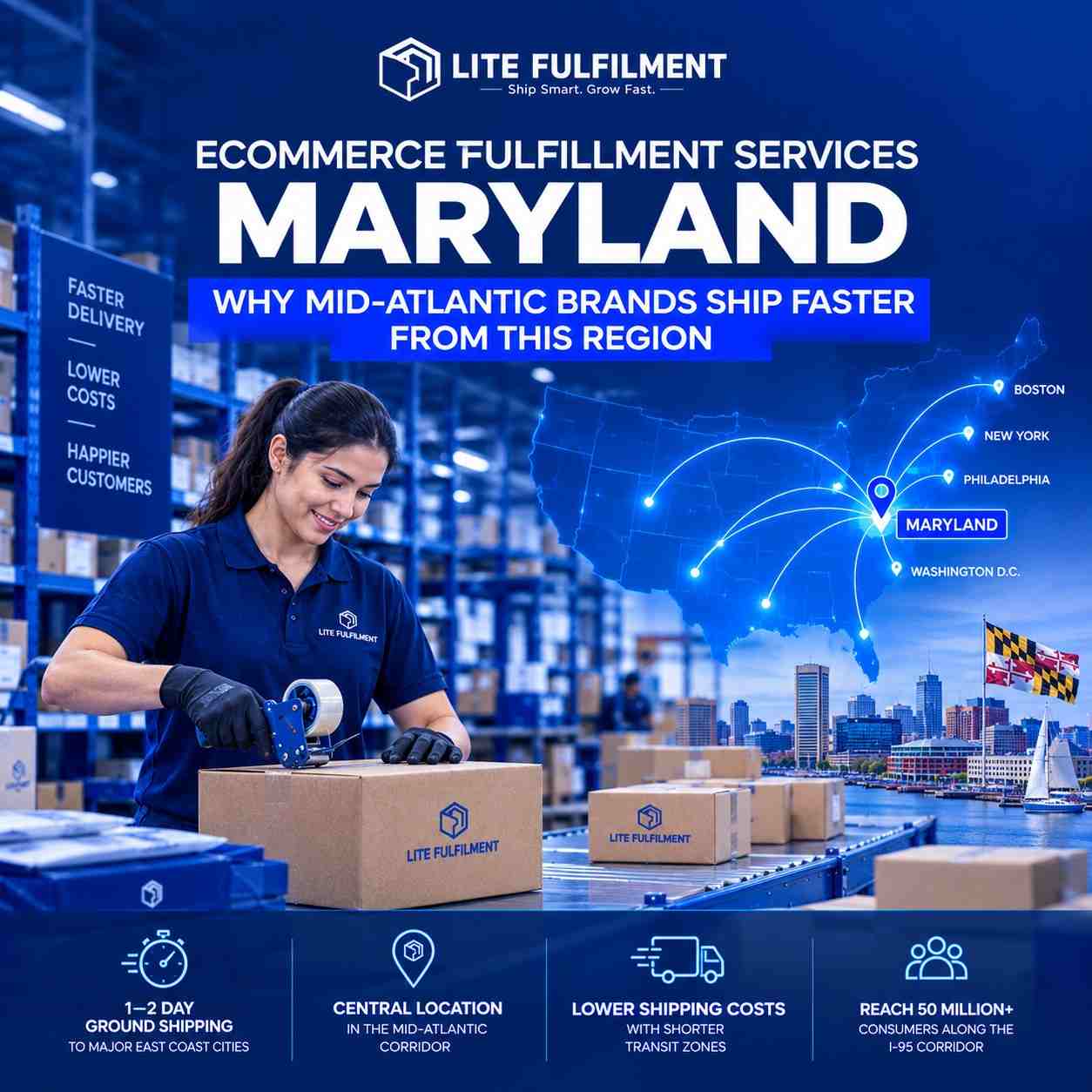
Ecommerce fulfillment services in Maryland put your inventory in the mid-Atlantic corridor. This region sits at the center of the East Coast's population density. A warehouse here reaches New York, Philadelphia, Washington D.C., and Boston within one to two day ground shipping.
For ecommerce brands based in Maryland, a mid-Atlantic fulfillment center cuts transit times. It also lowers shipping costs for East Coast customers. The question is not whether to use this region. The question is which specific location gives you the best coverage.
Why Maryland and the Mid-Atlantic Region for Ecommerce Fulfillment
Geography drives fulfillment performance. A warehouse closer to your customers means faster delivery and lower shipping rates. The mid-Atlantic region delivers both.
Population Density Favors the I-95 Corridor
The I-95 corridor from Boston to Washington D.C. holds over 50 million people. A fulfillment center along this route reaches the densest consumer market in the country. Baltimore, which sits in the middle of this corridor, connects to major carrier hubs.
Maryland's location also provides access to the Port of Baltimore. Brands importing products from overseas can move inventory from port to warehouse with minimal transit time. That shortens the gap between receiving inventory and shipping first orders.
Ground Shipping Reaches Most of the US in 2 to 4 Days
A mid-Atlantic warehouse does not just serve the East Coast. Ground shipping from this region reaches 80 percent of the US population within two to three business days. West Coast addresses take three to four days by ground.
Compare that to a warehouse in California. West Coast facilities serve local customers fast. But orders to the East Coast take five to seven days by ground. A mid-Atlantic location balances coverage across the entire country.
Carrier Hub Access Lowers Shipping Costs
UPS, FedEx, and USPS all operate major sorting facilities in the mid-Atlantic. Proximity to these hubs means faster carrier pickups and lower per-package rates. Your fulfillment center benefits from volume-based carrier discounts tied to regional shipping density.
Zone-based pricing rewards warehouses in central locations. A shipment from Maryland to Ohio costs less than one from California to Ohio. That difference multiplies across hundreds or thousands of daily shipments.
What to Look for in Maryland-Area Fulfillment Services
Not every warehouse in the mid-Atlantic offers the same capabilities. Here is what to evaluate before choosing a provider.
Platform Integration
Your 3PL must connect with every platform where you sell. Shopify, WooCommerce, Amazon, Walmart, TikTok Shop, and Etsy should all sync automatically. Orders from every channel flow into one queue.
Manual order entry creates delays. It also increases error rates. A connected fulfillment center processes orders within hours of placement.
Same-Day Processing and Shipping Cutoffs
Top fulfillment centers process orders the same day they come in. Ask about the daily cutoff time. An order placed at 2 PM should ship that afternoon, not the next morning.
Same-day processing directly affects delivery speed. A one-day delay at the warehouse adds one day to every customer's transit time.
FBA Prep and Multi-Channel Support
Many ecommerce brands sell on their own website and on Amazon. Your 3PL should handle both DTC fulfillment and FBA prep from one location. That keeps your inventory in a single pool.
Splitting inventory between a 3PL and an Amazon warehouse creates two problems. You manage two stock levels separately. And you risk overselling on one channel while product sits in the other.
Returns Processing
Returns are part of ecommerce. Your fulfillment center should inspect returned items, restock eligible products, and update inventory counts. A 3PL that does not handle returns forces you to manage that process separately.
Ask how the 3PL processes returns. How quickly do returned items get inspected? What percentage get restocked? These numbers affect your bottom line.
How Does Ecommerce Fulfillment Work in the Mid-Atlantic?
The fulfillment process follows five stages. Each one affects speed, accuracy, and cost.
Step 1: Inventory Receiving
Your products arrive at the warehouse from your manufacturer or supplier. Staff inspect the shipment, count units, and log everything into the warehouse management system. Accurate receiving prevents inventory errors from day one.
Step 2: Storage and Inventory Management
Products go into assigned storage locations. The WMS tracks every SKU by location, quantity, and status. Real-time inventory visibility across all sales channels prevents overselling.
Climate-controlled storage matters for certain product categories. Supplements, skincare, and electronics all need temperature-regulated environments.
Step 3: Order Processing
When a customer places an order, it flows into the 3PL's system. The order gets assigned to a picker. Processing speed is measured in hours, not days.
Step 4: Picking and Packing
A warehouse worker picks the correct items from storage. They verify the SKU and quantity. Then they pack the order using the right box size and protective materials.
Right-size packaging reduces dimensional weight charges. Carriers charge by box size, not just product weight. A box that fits the product saves money on every shipment.
Step 5: Shipping and Delivery
The fulfillment center selects the best carrier for each shipment. Rate shopping across UPS, USPS, and FedEx finds the lowest cost by destination and speed. Tracking information syncs back to your ecommerce platform automatically.
Maryland vs. Delaware: Which Mid-Atlantic Location Is Better?
Maryland and Delaware sit next to each other on the map. Both offer mid-Atlantic geographic advantages. The difference comes down to cost and tax structure.
Delaware Has No Sales Tax
Delaware is one of five US states with no sales tax. Maryland charges 6 percent. For ecommerce brands shipping physical products, Delaware's tax-free status saves money on every outbound order.
This matters most for B2B and wholesale shipments where tax calculations add complexity. Operating from a Delaware warehouse simplifies the process.
Delaware Offers Lower Operating Costs
Warehouse lease rates and labor costs in Delaware are generally lower than in Baltimore or the greater D.C. metro area. Those savings pass through to fulfillment pricing for brands using a Delaware-based 3PL.
Both States Reach the Same Markets
The geographic difference between a Maryland warehouse and a Delaware warehouse is negligible. Both reach 80 percent of the US population within the same shipping window. Carrier transit maps show nearly identical zone coverage.
The shipping performance is the same. The cost structure is not. Delaware gives you the same geographic reach at a lower total cost.
Common Mistakes When Choosing a Maryland-Area 3PL
Picking the Closest Warehouse to Your Office
Many brands choose a 3PL near their own location. If your office is in Baltimore, a Baltimore warehouse feels convenient. But convenience does not equal performance.
Choose your warehouse based on where your customers are. If you sell nationwide, a centrally positioned mid-Atlantic location outperforms a warehouse chosen for proximity to your office.
Ignoring Scalability
A small warehouse that handles 50 orders per day may not handle 500. Ask about peak season capacity. How does the 3PL scale staffing for Black Friday and Cyber Monday? What is their maximum daily throughput?
Growth that outpaces your 3PL's capacity leads to shipping delays and customer complaints.
Not Asking About Technology
A warehouse without a modern WMS creates blind spots. You need real-time inventory counts, automated order routing, and platform integration. A 3PL using spreadsheets and manual processes will slow your operation down.
How Lite Fulfillment Serves Maryland-Area Ecommerce Brands
Lite Fulfillment provides nationwide US fulfillment from our warehouse in Delaware. We are located minutes from the Maryland border with the same mid-Atlantic geographic advantages. We serve 500+ brands with a 99.98 percent order accuracy rate.
Our Delaware location ships to all 50 states and over 200 countries. We connect with Shopify, WooCommerce, Amazon, TikTok Shop, and other major platforms. Orders process same-day with automated carrier rate shopping.
Delaware's tax-free status and lower operating costs mean better fulfillment pricing than most Maryland-based warehouses. You get the same shipping zones at a lower total cost.
Get a free quote and see how a Delaware warehouse gives Maryland-area brands better fulfillment without higher costs.