

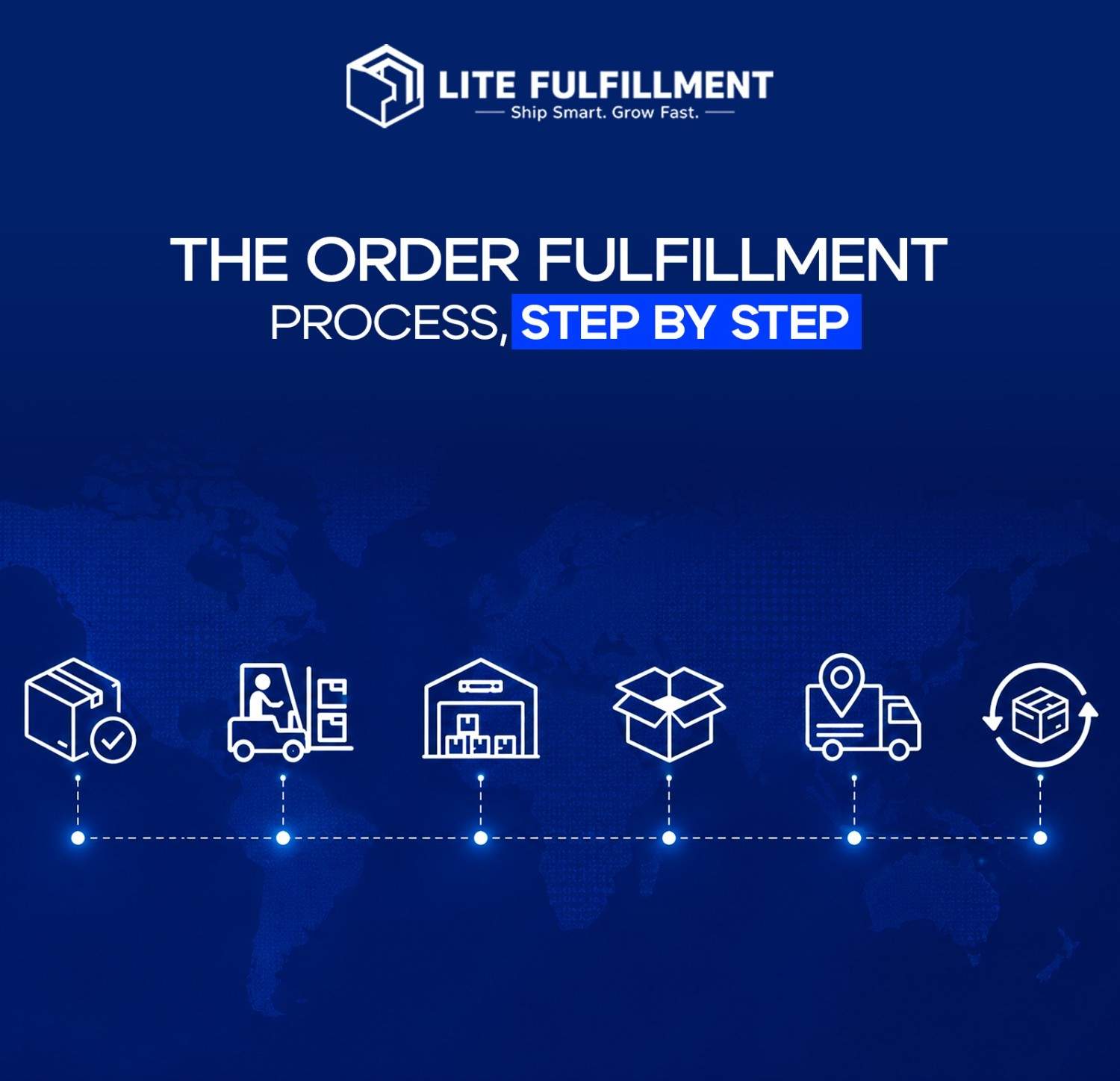
The order fulfillment process moves an order from cart to customer through seven stages: inbound receiving, putaway and storage, order capture, picking, packing, shipping, and post-purchase tracking. Each stage is a separate operational event with its own systems and its own failure modes. Together they form the workflow between a customer clicking "place order" and a parcel arriving at their door. This guide walks through every stage the way it actually runs on a warehouse floor, names the failure that shows up first at each volume tier, and gives you a diagnostic to find the step quietly costing your brand the most money.
What Is the Order Fulfillment Process?
The order fulfillment process is the operational chain that receives inventory, holds it, and turns customer orders into shipped parcels. It sits on top of the wider supply chain (manufacturing, freight, customs), but fulfillment itself is the last-mile execution: receive, store, pick, pack, ship, track. If you want the wider picture of how this fits a growing store, our overview of ecommerce order fulfillment covers the service side.
Most guides stop at seven steps. In practice, there is an invisible eighth step that decides whether the other seven stay accurate: daily reconciliation. At the end of every shift, the physical count on the shelf, the system count in the WMS, and the available-to-sell count on Shopify, Amazon, Walmart, and any other connected channel are compared and rebalanced. Skip reconciliation and inventory drift compounds silently for weeks until a stockout, a phantom oversell, or a mystery shrinkage number reveals it. Every accuracy problem in fulfillment eventually traces back to a reconciliation habit that was never built.
If you take one thing from this guide, take that: the seven steps are the workflow, and reconciliation is what keeps the workflow honest.
The 7 Steps of the Order Fulfillment Process (At a Glance)
Here is the full process with the typical time each step takes, the failure that shows up first when it breaks, and where that failure quietly costs your brand money.
| Step | Typical Time | Primary Failure Mode | Where It Costs You |
|---|---|---|---|
| 1. Inbound Receiving | 30 to 90 sec per SKU line | Miscount against packing list | Shrinkage compounds across the SKU lifecycle |
| 2. Putaway & Storage | 15 to 30 sec per SKU | Fast-movers in slow-mover zones | Adds 30 to 60 sec per pick, every pick |
| 3. Order Capture | Seconds (automated) | Address validation failure | 2 to 5% return-to-sender on bad addresses |
| 4. Picking | 60 to 180 sec per order | No scan verification at pick | Accuracy drops below 98%, chargebacks rise |
| 5. Packing | 45 to 120 sec per order | Oversized box selection | Dimensional weight adds 15 to 30% to shipping |
| 6. Shipping | Seconds (auto-rated) | Wrong customs paperwork | International holds add 3 to 10 days transit |
| 7. Post-Purchase | Ongoing | No proactive tracking updates | WISMO tickets spike, repeat rate falls |
Every one of these times and failure modes comes from real production data across our brand base. Your numbers will vary by SKU profile and order mix, but the shape of the failures is remarkably consistent.
Each Step Explained: What Happens, Where It Breaks, How to Check
Step 1: Inbound Receiving
What happens: A shipment arrives at the dock. The receiving team counts every unit against the packing list, checks for damage, and flags any SKU mismatches before a single item is put away.
Where it breaks: When shipments arrive without an advance shipment notice (ASN), the team has to build a count from scratch. Errors slip in, damage goes unlogged, and the receiving system carries the wrong number forward for the life of the SKU.
How to check yours: Pull your last 30 receipts. Count how many were received against an ASN and how many were reconstructed at the dock. If more than 20% arrived without an ASN, this step is your leak.
Step 2: Putaway and Storage
What happens: Each SKU is scanned into a specific bin, shelf, or pallet location in the WMS. Fast-movers get positions near the pack stations. Slow movers go deeper. Fragile and oversize items get their own zones.
Where it breaks: Nobody re-slots as demand changes. A SKU that was moderate volume six months ago is now your bestseller and it is still sitting in aisle 12. Every pick takes an extra 30 to 60 seconds, and over a few thousand orders a month that is a real labor line.
How to check yours: Ask your warehouse or 3PL when the last slotting review was done. If the answer is more than 90 days ago, you are paying for old slotting. Keeping this organized is the core of warehouse storage and inventory management.
Step 3: Order Capture and Verification
What happens: A customer places an order on Shopify, Amazon, Walmart, WooCommerce, TikTok Shop, or another connected channel. The order flows through the OMS into the WMS. Fraud checks, address validation, and split-shipment logic run automatically.
Where it breaks: Address validation is skipped or set too permissive. Bad addresses print as pick sheets, get picked, get packed, ship, then bounce back as return-to-sender. Every RTS costs you a full order cycle, a refund, a customer-service ticket, and the outbound shipping fee.
How to check yours: Look at your RTS rate over the last 90 days. Anything above 2% is a validation problem, not a customer problem.
Step 4: Picking
What happens: A picker pulls each SKU on the order from its storage location. Four common pick and pack methods exist: single-order, batch, zone, and wave picking. The right method depends on order profile.
Where it breaks: Picks that are not scanned against the WMS cannot be audited. When accuracy drops, you find out from customer complaints, not from your dashboard. A pick that isn't scanned is a pick you cannot verify.
How to check yours: Ask what percentage of picks in your operation are scan-verified. If it is less than 100%, that is where your accuracy is leaking. Our own 99.98% order accuracy across 500+ brands is downstream of one thing: every pick gets scanned.
Step 5: Packing
What happens: The packer confirms the SKU, chooses the right box or mailer, adds the right dunnage (void fill, bubble, kraft paper), places any inserts, and applies the shipping label.
Where it breaks: Oversized boxes are the single most common packing mistake. Carriers charge on the greater of actual or dimensional weight, so a small item in a big box is a shipping fee you pay every time. On international shipments, wrong dunnage becomes damage claims because the parcel handles more than a domestic order does.
How to check yours: Sample 20 recent outbound parcels. Weigh each and measure the box. If more than a quarter of them are more than 40% empty space, your packer is defaulting to whatever box is closest and you are paying for the air.
Step 6: Shipping and Label Generation
What happens: The parcel is weighed, rated across carrier options (USPS, UPS, FedEx, DHL for international), and the cheapest compliant label is generated. The parcel is sorted by carrier and picked up on the daily manifest. International orders also generate the commercial invoice, customs declaration, HS codes, country-of-origin, and DDP or DDU designation.
Where it breaks: Getting the customs paperwork wrong sends the shipment into a bonded warehouse for days. The parcel is fine. The paperwork is not.
How to check yours: Pull your last 50 international shipments. Count customs holds and delays. If more than 5% held, your paperwork upstream is the problem, not the carrier.
Step 7: Tracking, Delivery, and Post-Purchase
What happens: The tracking number pushes back to the customer, delivery confirmation fires to the store, returns and exchanges are processed, and WISMO ("where is my order") tickets are handled.
Where it breaks: A brand that ships fast but ghosts the customer during transit loses repeat orders. Support tickets pile up. Trust erodes.
How to check yours: Count your WISMO tickets as a percentage of shipped orders. Under 3% means your post-purchase visibility is working. Over 5% means the customer is being kept in the dark. Clean returns handling belongs in returns management so restock and disposition stay accurate.
Which Step Is Costing You the Most Money? A Self-Diagnostic
Most brands know something in fulfillment is broken. Few can name which of the seven steps is responsible. Use the symptoms below to isolate it before spending money on the wrong fix.
| What You Are Seeing | Most Likely Broken Step | First Thing to Check |
|---|---|---|
| Late shipments at normal volume | Step 4 or Step 5 throughput | Cart-to-label cycle time by hour |
| Wrong-item complaints rising | Step 4 (picking accuracy) | % of picks scan-verified |
| Damage-in-transit claims rising | Step 5 or Step 6 (carrier mix) | Void fill ratio and carrier by lane |
| Unexplained stock discrepancies | Step 1 or missing reconciliation | ASN compliance on last 30 receipts |
| Return-to-sender above 2% | Step 3 (address validation) | OMS validation settings |
| Orders held at customs | Step 6 (paperwork) | HS code accuracy and declared value |
| WISMO surge, refund requests | Step 7 (tracking notifications) | Time from label to first tracking event |
Run through this table once a quarter. The step that keeps showing up as "most likely broken" is your bottleneck, and no other investment in fulfillment will pay back until it is fixed.
What Breaks First at Each Volume Tier
The order fulfillment process fails in different places depending on volume. Recognizing which tier you are in tells you where to look first.
| Monthly Order Volume | What Breaks First | Why |
|---|---|---|
| Under 500 orders/month | Step 5: packing throughput | The founder is packing boxes and other work stops when volume spikes |
| 500 to 2,000 orders/month | Step 2: putaway and slotting | SKUs proliferate faster than anyone re-slots. Pick paths blow up |
| 2,000 to 10,000 orders/month | Step 4: picking accuracy | Manual, non-scanned picking cannot keep up with SKU count and human error compounds |
| 10,000 to 50,000 orders/month | Step 1: receiving discipline | ASN sloppiness and no reconciliation habit surface as chronic inventory drift |
| 50,000+ orders/month | Step 7: post-purchase and returns | Support volume outruns the team, retention drops even as fulfillment holds |
In-House vs 3PL: Which Steps to Outsource First
The usual pitch is "outsource everything to a 3PL." That is not how most successful brands actually do it. Fulfillment is seven separable operations. Some brands hand over all seven. Many hand over four or five and keep the rest in-house because those steps sit closer to brand experience.
Here is the honest breakdown of which steps are the highest-return to outsource and which are worth keeping close, and if you are weighing it fully, our guide on what a 3PL is covers the model.
| Step | Outsource ROI | Notes |
|---|---|---|
| 1. Inbound Receiving | High | Warehouse labor is a fixed cost the 3PL spreads across brands |
| 2. Putaway & Storage | High | Space cost per unit falls sharply at 3PL scale |
| 3. Order Capture | Medium | Worth it mainly if your channels are not already API-connected |
| 4. Picking | High | Scan-verified picking at scale beats most in-house setups |
| 5. Packing | High | A 3PL sources packaging at volume and knows dimensional math |
| 6. Shipping | Very high | Enterprise carrier rates are the single biggest cost saving |
| 7. Post-Purchase | Split | Physical returns to the 3PL; brand voice and retention stay in-house |
Most brands we work with keep step 7 partially in-house. Their team handles the customer conversation. Our team handles the physical return, inspection, restock, or disposition. That split protects brand voice without giving up the operational cost advantage.
A Real Wednesday at Our Warehouse
Here is how the order fulfillment process actually runs on a normal Wednesday at our facility in Wilmington, Delaware.
Orders start syncing from connected stores at 6:00 AM as the overnight batch clears. Everything placed before our 2:00 PM same-day cutoff is queued in that morning window. At 7:30 AM the WMS releases the first pick wave. Pickers work in zones, scanning each SKU as it enters a tote. Totes flow to pack stations by 9:30 AM. Packing runs continuously through the day.
First carrier pickup is at 1:00 PM, second at 5:00 PM. International orders and Amazon FBA prep services inbound shipments run in separate lanes with separate paperwork queues, because customs errors and Amazon inbound errors have consequences you do not want mixing into your standard outbound flow.
Inbound receiving runs on a completely separate track: dock appointments, count, quality check, putaway. Receiving and outbound never share labor pool during peak hours. That separation is the reason a heavy inbound day does not slow same-day dispatch. Every brand we onboard eventually asks why we insist on this. The answer is that mixed lanes are how small operational problems become customer-facing failures.
The KPIs That Actually Predict Failure
Most fulfillment scorecards track lagging indicators. Order accuracy tells you a problem happened. On-time shipping tells you a problem happened yesterday. By the time these numbers move, customers have already been affected.
Leading indicators move first. Track these and you catch problems before customers do.
| KPI | Lagging or Leading | Target | What It Tells You |
|---|---|---|---|
| Order Accuracy Rate | Lagging | 99.5%+ | Whether picking and packing were right |
| On-Time Shipping Rate | Lagging | 98%+ | Whether cutoffs were hit |
| Scan Verification Rate | Leading | 100% | Whether accuracy can be audited |
| Cart-to-Label Cycle Time | Leading | Under 24 hours | Whether the pipeline is healthy hour by hour |
| Address Validation Pass Rate | Leading | 98%+ | Whether RTS pain is coming |
| Dock-to-Stock Time | Leading | Under 24 hours | Whether inventory is being made sellable fast enough |
| Inventory Accuracy | Leading | 99%+ | The KPI that moves first when anything is off |
| Cost Per Order | Trend | Down over time | Whether the operation is improving |
| Return Rate | Diagnostic | Track by SKU | Whether it's a fulfillment issue or a product issue |
If you can only track one KPI, track inventory accuracy. It moves first when receiving discipline slips, when reconciliation is skipped, when slotting drifts, and when picking accuracy falls. Every other number in fulfillment is downstream of it.
Signals It's Time to Move to a 3PL
The usual advice is "outsource when you hit X orders per month." That is oversimplified. Volume alone does not decide it. These signals do.
- You are pulling time away from growth work to pack boxes. If the founder or the marketing team is on the pack station, the math has already turned negative.
- You have missed a shipping cutoff more than twice in the last 30 days. That is not a bad-week problem. That is a capacity problem.
- Order accuracy has dropped below 98%. Every point below 98 is customer trust bleeding out. Fixing it in-house is more expensive than moving to a scan-verified 3PL.
- You are entering a new international corridor. Customs paperwork, carrier relationships, and duty handling are not learn-as-you-go. Get a partner who ships that lane every day.
- Peak season is six weeks away and you already know you cannot handle it. The worst time to switch fulfillment is during peak. The second-worst is right after peak, when everyone else is also switching.
- You cannot answer "which step is my bottleneck?" If the diagnostic in this guide didn't give you a clear answer, you don't have the visibility to fix it in-house.
FAQ
The seven steps are inbound receiving, putaway and storage, order capture and verification, picking, packing, shipping and label generation, and post-purchase tracking. A disciplined operation adds an eighth habit, daily reconciliation, which compares physical, WMS, and channel counts at the end of every shift to stop inventory drift before it causes a stockout or oversell.
Match the symptom to the step. Wrong-item complaints point to picking accuracy. Damage claims point to packing or carrier mix. Return-to-sender above 2% points to address validation. Customs holds point to paperwork. Run the self-diagnostic table once a quarter, and the step that keeps surfacing as most likely broken is your bottleneck.
Shipping is one step inside the order fulfillment process. Fulfillment is the full chain: receiving, storing, capturing the order, picking, packing, then shipping, then post-purchase tracking and returns. Shipping only covers rating the parcel, generating the label, and handing it to a carrier such as USPS, UPS, FedEx, or DHL.
In a healthy operation, an order placed before the same-day cutoff ships that day, and cart-to-label cycle time stays under 24 hours. Dock-to-stock on inbound should also stay under 24 hours so new inventory becomes sellable fast. International orders add customs processing time on top of the domestic clock.
Track order accuracy (99.5%+), on-time shipping (98%+), and cost per order as outcomes. More useful are leading indicators: scan verification rate (100%), cart-to-label cycle time, address validation pass rate, and inventory accuracy. Inventory accuracy moves first when anything upstream slips, so it is the best early warning.
No. Plenty of brands run all seven steps in-house at low volume. The math changes when the founder is packing boxes, accuracy drops below 98%, you keep missing cutoffs, or you enter a new international corridor. At that point a scan-verified partner usually costs less than fixing the leak in-house.
Yes. Fulfillment is seven separable operations. Many brands hand a 3PL receiving, storage, picking, packing, and shipping while keeping customer communication and retention in-house. Physical returns processing usually belongs at the 3PL, while the brand keeps the customer conversation to protect its voice.
What This Means for You
The order fulfillment process is seven stages that look simple on paper and get unforgiving in execution. Most brands do not have a fulfillment problem in the abstract. They have a specific broken step and a compounding cost they can't yet name. Run the diagnostic in this guide, identify which of the seven stages is bleeding you, and fix that one first. It will save more than any generic "switch to a 3PL" decision made without diagnosis.
If you want the seven-step order fulfillment process running cleanly for your brand, we can help.