

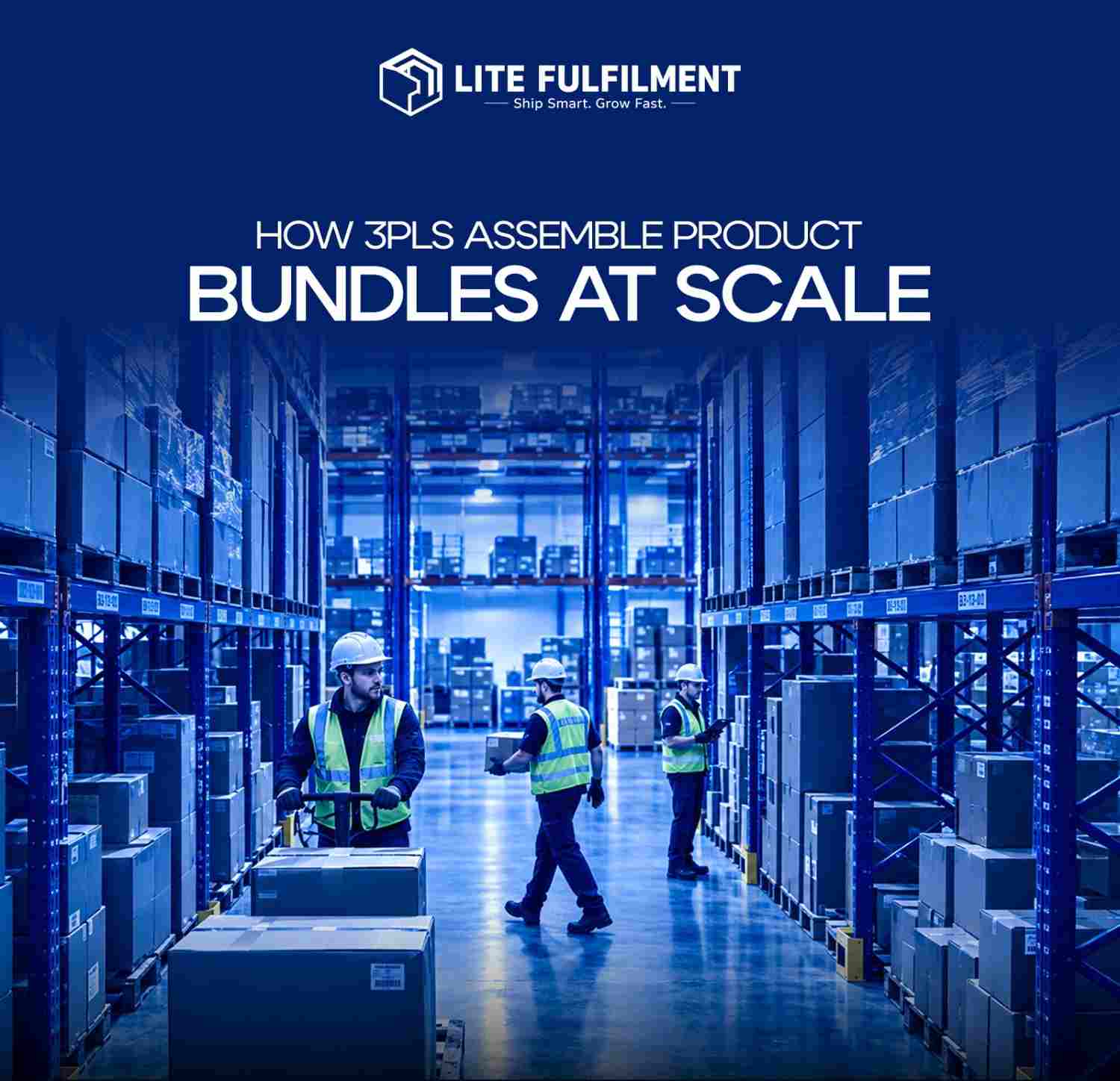
Warehouse bundling services handle the assembly of multiple products into a single sellable unit inside a fulfillment center. The warehouse groups them into one bundle before an order even comes in. One package ships instead of three.
This happens inside the warehouse, not at your office or your manufacturer's facility. That distinction matters. Bundling at the warehouse level connects directly to your inventory system and shipping operation. Everything stays in one location.
How Warehouse Bundling Works Step by Step
Bundling inside a fulfillment center follows a specific workflow. Each stage affects accuracy, speed, and inventory visibility.
Component Receiving and Inspection
Individual products arrive at the warehouse from your manufacturer or supplier. Staff inspect each component, count units, and log them into the warehouse management system as individual SKUs. Each component keeps its own inventory record.
This step is critical for bundling. If a component arrives short or damaged, the warehouse cannot build the full quantity of bundles. Early detection at receiving prevents production delays.
Bundle Assembly
Warehouse workers pull the correct components from storage and assemble them into the finished bundle. A simple bundle might be three units of the same product shrink-wrapped together. A complex bundle might include five different items in custom packaging with inserts.
Assembly happens in dedicated workstations. Workers follow a bill of materials that lists every component, its quantity, and the packaging requirements. Quality checks verify that each bundle contains the right items before sealing.
New SKU Assignment
The finished bundle gets its own SKU in the warehouse management system. This is separate from the component SKUs. When a customer orders the bundle, the system picks it as one unit from the bundle storage location.
Dual tracking is important here. The system needs to show both the finished bundle inventory and the remaining component inventory. This prevents a common problem. You show bundles available for sale while one component is already out of stock.
Storage and Inventory Sync
Assembled bundles go into designated storage locations. The WMS tracks them alongside individual component inventory. When bundles sell, the system deducts component quantities accordingly.
This inventory sync must flow to your sales channels. Shopify, Amazon, WooCommerce, and every other platform should reflect accurate bundle availability based on real-time component stock.
What Types of Bundles Can a Warehouse Assemble?
Multi-Pack Bundles
Three-packs, six-packs, and bulk quantities of a single product. Common in supplements, personal care, and consumable goods. Assembly is straightforward. The warehouse groups identical units and wraps or boxes them together.
Mixed Product Bundles
Two or more different products packaged as one. A coffee brand might bundle a bag of beans with a branded mug. A pet brand might combine treats, a toy, and a collar in one box. Assembly requires pulling from multiple storage locations.
Promotional and Seasonal Bundles
Limited-time bundles tied to holidays, product launches, or marketing campaigns. These change frequently. A warehouse bundling provider needs the flexibility to assemble new configurations without long lead times.
Subscription Bundles
Monthly or quarterly boxes with rotating contents. Each cycle may include different products. The warehouse must manage changing bills of materials and assemble large quantities within tight ship windows.
Amazon FBA Bundles
Bundles sold on Amazon need FBA-compliant packaging. Each bundle requires an FNSKU label. Poly bagging applies if any component is loose. Carton-level labels must match the Amazon shipment plan. Your warehouse should handle all of this during the bundling process.
Why Bundle at the Warehouse Instead of the Manufacturer?
Some brands ask their manufacturer to pre-assemble bundles before shipping to the warehouse. This works in limited situations. For most brands, bundling at the warehouse is more flexible and less risky.
Faster Response to Market Changes
A manufacturer in China needs weeks of lead time to change a bundle configuration. A warehouse in the US can update a bundle in days. If a promotion changes or a product goes out of stock, the warehouse adjusts fast. No waiting for a new production run overseas.
Lower Minimum Order Quantities
Manufacturers often require minimum runs of 1,000 or 5,000 units for bundled products. A warehouse bundles in whatever quantity you need. Run 100 units for a test campaign. Scale to 5,000 when the campaign succeeds.
Component Flexibility
Keeping components separate at the warehouse gives you options. You can sell each product individually and as part of a bundle simultaneously. If one component sells faster individually than expected, you adjust bundle production without losing sales on either front.
What Should You Look for in a Warehouse Bundling Provider?
Component-Level Inventory Tracking
The provider must track each individual component and each finished bundle as separate SKUs. Without this, you cannot see when a component is running low. You find out only when the bundle cannot be assembled.
Quality Control During Assembly
Errors in bundle assembly are expensive. A missing item triggers a customer complaint, a replacement shipment, or a refund. Your provider should use checklists or barcode scanning during assembly to verify contents before sealing.
Flexible Assembly Capacity
Your bundling needs will change. Holiday seasons bring spikes. New product launches create new bundle configurations. A provider with rigid assembly schedules cannot keep up with a growing brand.
Ask about turnaround time for new bundle setups. Ask about peak season capacity. A good provider assembles new bundles within days of receiving components.
Sales Channel Integration
Bundle inventory must sync with your ecommerce platforms. When a customer buys a bundle on Shopify, the system should deduct component inventory across all channels. Without this sync, you risk overselling bundles or components on another platform.
How Does Warehouse Bundling Affect Shipping Costs?
Bundling reduces shipping costs in two ways.
Fewer Packages Per Customer
A customer ordering three individual products generates three separate shipments. That same customer buying a three-item bundle generates one shipment. The per-order carrier cost drops by roughly two-thirds.
Lower Dimensional Weight
Three products packed together in one right-sized box weigh less dimensionally than three separate packages. Carriers charge by dimensional weight when it exceeds actual weight. Bundling reduces the total cubic inches per order.
For brands shipping hundreds of orders per day, these savings add up fast. A $2 reduction in average shipping cost across 500 daily orders saves $1,000 per day.
Common Bundling Mistakes to Avoid
Not Tracking Component Inventory Separately
Tracking only the finished bundle inventory creates blind spots. You sell bundles on your website until one component runs out. Then you cannot fulfill orders and must cancel them. Component-level tracking prevents this.
Over-Building Bundles Before Demand Is Proven
Assembling 5,000 bundles for a new product launch feels proactive. If the bundle does not sell, you have 5,000 units of packaging and labor invested in dead inventory. Start with smaller runs. Scale up when demand confirms the configuration works.
Using Oversized Packaging
A bundle shipped in a box twice the needed size costs more to ship. Dimensional weight charges increase with box volume. Your warehouse should match packaging dimensions to the bundle's actual size.
How Lite Fulfillment Handles Warehouse Bundling
Lite Fulfillment provides kitting and bundling services from our warehouse in Delaware. We serve 500+ brands with a 99.98 percent order accuracy rate. We ship to all 50 states and over 200 countries.
Our bundling operation tracks components and finished bundles as separate SKUs. We handle multi-pack bundles, mixed product sets, subscription boxes, and Amazon FBA prep under one roof. Bundle configurations update within days, not weeks.
We connect with Shopify, WooCommerce, Amazon, TikTok Shop, and other platforms. Component inventory syncs across all channels in real time.
Get a free quote and see how warehouse bundling from Delaware helps your brand ship faster and spend less per order.