
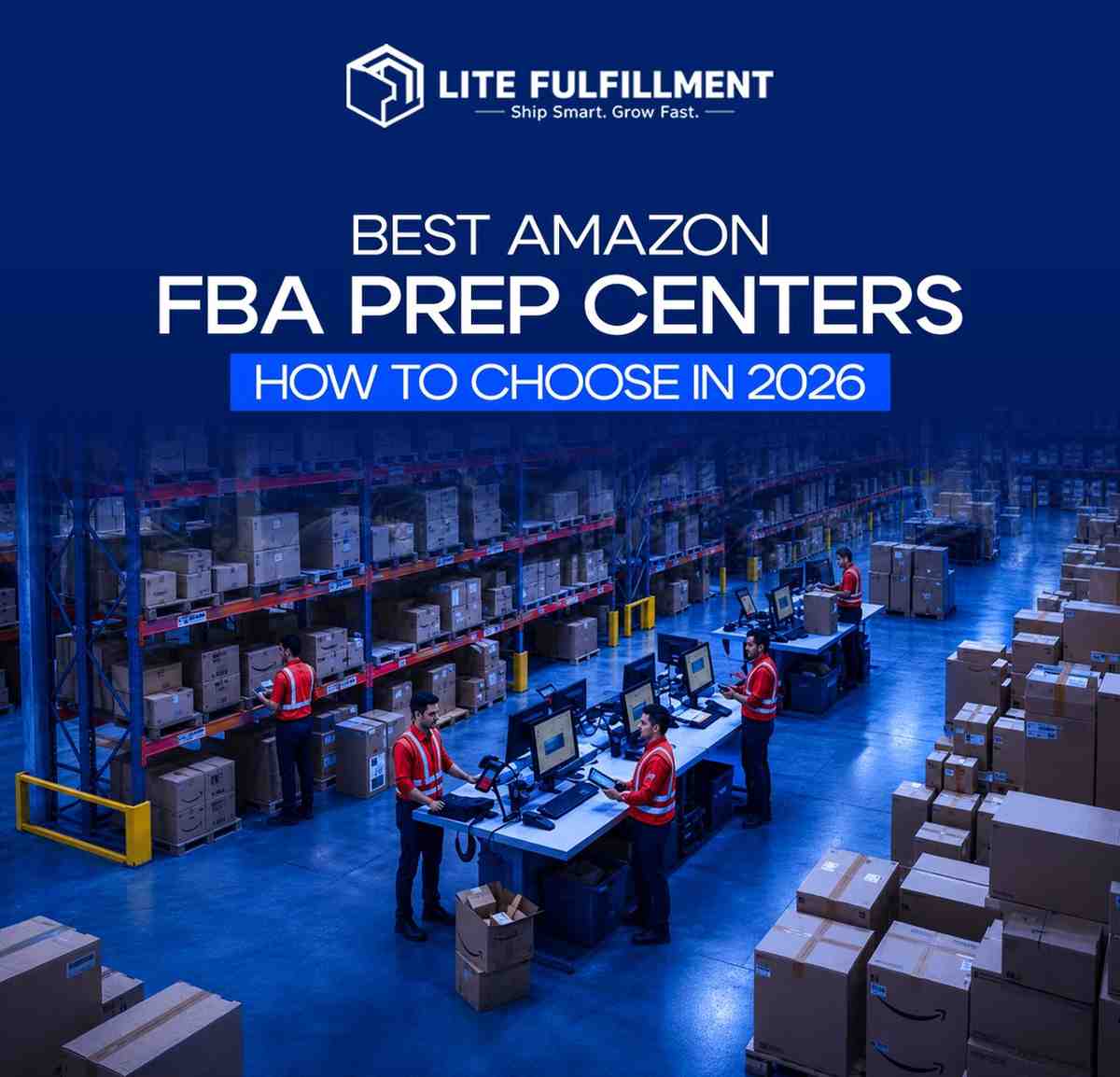
Picking the wrong Amazon FBA prep center can cost you more than money. It can get your shipments rejected at the fulfillment center, trigger stranded inventory, and quietly eat your margins through slow turnaround and hidden fees. Since Amazon ended its own prep and labeling services on January 1, 2026, and shut down commingled inventory on March 31, 2026, every seller now has to choose an outside partner. That shift turned "which prep center should I use" into one of the most important operational decisions an Amazon business makes this year.
This guide walks through how to evaluate the best Amazon FBA prep centers, what to check before signing, and where the real trade-offs sit. It is written from the inside of a working prep operation, not from a checklist someone found on page one of Google.
Why the FBA Prep Landscape Changed in 2026
For years, sellers could send loose, un-prepped inventory to Amazon and let Amazon do the poly bagging, labeling, and bundling for a per-unit fee. That safety net is gone. Amazon's Seller Central prep requirements now put full responsibility on the seller or their prep partner. Miss a barcode, skip a suffocation warning, or ship an item in the wrong packaging and the shipment gets refused, quarantined, or worse, destroyed at your cost.
The commingled inventory change hit even harder for sellers who relied on virtual pooling. Every unit now has to carry your FNSKU, which means every unit has to be physically prepped before it hits an Amazon fulfillment center.
This is why prep centers moved from a nice-to-have to core infrastructure. And why picking the right one matters more in 2026 than it did in any previous year.
What a Good FBA Prep Center Actually Does
Prep is not just sticking a label on a box. A prep center that knows what it is doing will handle:
- Receiving inbound freight from your supplier, whether that is a domestic vendor or a container from China
- Inspecting units for damage, missing components, or manufacturer defects before they ever reach Amazon
- FNSKU labeling with scannable, correctly formatted barcodes
- Poly bagging with suffocation warnings on any item over five inches on any side
- Bubble wrapping fragile items and applying "Fragile" or "This Side Up" stickers where required
- Bundling multi-packs and applying "Sold as Set" or "Do Not Separate" labels
- Expiration date labeling for consumables and topicals
- Building compliant Amazon shipments in Seller Central, printing box labels, and booking the inbound
- Handling FBM orders in parallel so you are not running two operations
If a prep center only does a subset of this, you will end up managing gaps yourself. That defeats the purpose.
Eight Criteria for Choosing the Best Amazon FBA Prep Center
Use this as the actual scorecard when you talk to prep centers. Every question below has a right answer, and vague answers should be treated as red flags.
1. Location and Sales Tax Exposure
Where the prep center sits changes your inbound freight cost and, in some cases, your tax bill. Sales tax-free states like Delaware, Oregon, Montana, and New Hampshire mean your inbound inventory does not get taxed on entry. For sellers importing high-ticket goods, that difference is real money.
Location also affects transit time to Amazon fulfillment centers. An East Coast prep center gets to most of the ATL, MDW, EWR, and PHL clusters faster than a West Coast one. If your inventory comes from Chinese suppliers via the West Coast, a West Coast prep center saves on drayage. If it comes from European or East Coast suppliers, the East Coast wins.
2. Turnaround Time
Ask for a specific commitment, not a range. "Same-day" or "24 to 48 hours from receipt to Amazon-bound" is the standard you should expect from a serious operator. Anything longer than 72 hours during a normal week means the center is either understaffed or overbooked. During Q4, expect this to stretch and get the specific Q4 SLA in writing before you commit.
3. Accuracy Rate
Ask for their measured accuracy rate on outbound shipments. A good prep center tracks this per unit and per shipment. If they cannot give you a number, they are not measuring it, which means they cannot manage it. At Lite Fulfillment we operate to a 99.98% order accuracy standard, and we can tell you how we count it.
4. Pricing Model and What Is Actually Included
The single biggest source of prep center disappointment is unclear pricing. Get a written breakdown of:
- Per-unit prep fee, and what "prep" specifically covers at that rate
- Receiving fees, per pallet or per carton
- Storage fees, per cubic foot or per pallet per month
- Special handling fees for fragile, oversize, or hazmat
- Inbound labor for opening master cartons and sorting
- Outbound freight to Amazon, and whether they book it or you do
A center offering the lowest per-unit rate but charging $75 to receive a pallet and $2 per unit for poly bagging is not cheaper. Model the full cost against your actual SKU mix before you decide.
5. Software and Visibility
You should be able to see inbound receipts, current on-hand counts, prep status, and outbound shipments without emailing anyone. If the prep center is running on spreadsheets and WhatsApp updates, walk away. Real-time inventory visibility is table stakes in 2026.
6. Communication and Account Management
Ask who your point of contact will be. If the answer is "our support team" and you get shuffled between tickets, that is going to become a problem the first time a shipment goes sideways. A named account owner who knows your SKUs is worth a premium.
7. Compliance and Handling for Regulated Categories
If you sell supplements, cosmetics, food, or anything else with FDA touchpoints, the prep center needs GMP-aligned handling, temperature-controlled storage where relevant, and lot tracking. Ask for their process for expiration date checks and FIFO rotation. Do not accept "we handle that" as an answer. Ask for the specific steps.
8. Contract Terms
Long lock-in contracts and monthly minimums are a legacy 3PL trait that does not fit how modern Amazon sellers operate. Volume moves up and down. Product mix changes. The best Amazon FBA prep centers offer month-to-month terms with no minimums, so you can scale in and out without penalty.
Comparison of the Main Types of FBA Prep Centers
Not every prep center is built for every seller. Here is how the categories actually differ.
| Type | Best For | Trade-Offs |
|---|---|---|
| Small local prep center | Sellers doing under 1,000 units per month, single category | Limited scaling capacity, often no software portal, patchy Q4 coverage |
| FBA-only prep specialist | Sellers focused purely on Amazon, high volume, standard SKUs | Cannot help when you expand to Shopify, Walmart, or DTC |
| Full-service 3PL with FBA prep | Sellers running Amazon plus DTC, Shopify, Walmart, or wholesale | Slightly higher per-unit rate, but consolidates operations |
| International prep hub | Sellers importing from overseas, selling globally | Best fit if you need cross-border shipping, IOR support, and multi-market fulfillment under one roof |
A seller doing 200 units a month of one product does not need the same partner as a brand shipping 40,000 units across FBA, Shopify, and TikTok Shop. Match the operator to your actual complexity.
Step-by-Step: How to Vet an Amazon FBA Prep Center
Follow this sequence, and you will avoid nine out of ten bad decisions.
Write down your monthly volume, SKU count, and category mix. This is the foundation of every quote you will get.
Shortlist three to five prep centers. Filter by location, category experience, and whether they handle FBM alongside FBA.
Request a full written fee schedule from each. Not a starting rate. Every line item.
Ask for their accuracy rate, average turnaround, and Q4 SLA. Get numbers.
Model the total cost against your actual SKU mix. Include receiving, prep, storage, and outbound.
Send a small test batch, 50 to 200 units. Watch how they receive, prep, and ship it. This tells you more than any sales call.
Check inbound shipment status in Seller Central. Look for accurate box content, correct FNSKU placement, and clean receiving at Amazon.
Confirm month-to-month terms and clear exit language before signing.
Sellers who skip step six almost always regret it. A test batch is the cheapest insurance you will buy this year.
💡 Pro tip: A test batch tells you more about a prep center in one shipment than a month of sales calls. Never skip it.
Red Flags That Should Kill a Deal
- No written pricing, only verbal quotes
- No portal or dashboard for inventory visibility
- Vague answers about accuracy or Q4 capacity
- Requires a long-term contract or monthly minimum
- Uses a personal email or WhatsApp as the only support channel
- Refuses to accept a test batch before you commit
- Cannot produce photos of the actual warehouse
Any one of these is enough to disqualify a prep center. Two together and you are looking at a partner who will disappoint you when volume gets tight.
Where Lite Fulfillment Fits
Lite Fulfillment runs FBA prep out of our Wilmington warehouse, which sits in a 0% sales tax state and gives us fast inbound access to the East Coast Amazon network. We handle FNSKU labeling, poly bagging, bundling, expiration date checks, and inbound shipment creation, alongside FBM orders and multi-channel fulfillment for Shopify, Walmart, TikTok Shop, and WooCommerce sellers.
We work with 500+ brands, ship to 200+ countries, and operate to a 99.98% order accuracy standard with same-day dispatch on qualifying orders. There are no long-term contracts and no monthly minimums. If you want to see the full service definition, our Amazon FBA prep page walks through exactly what is included. If you want to understand the prep workflow itself, our guide on what Amazon FBA prep involves breaks down the operational steps. And if location matters to your inbound strategy, our Delaware fulfillment center page explains the East Coast advantage in more detail.
Prep pricing depends on your SKU mix and volume, so we build a custom quote rather than publishing a one-size rate card. Reach out through our contact page with your monthly volume, and we will send a full fee schedule the same day.
Conclusion
The best Amazon FBA prep center for you is not the cheapest one on Google. It is the one that fits your SKU mix, matches your volume, is honest about its pricing, and communicates like a partner rather than a vendor. Since Amazon exited its own prep and commingled inventory in early 2026, sellers no longer have a safety net for sloppy prep. Pick the partner who takes that seriously.
Run the eight-point scorecard, send a test batch, and only sign month-to-month. Do those three things and you will avoid almost every mistake that costs sellers money this year.
Ready to talk to us? Contact Lite Fulfillment at hamza@litefulfillment.com or +1 (302) 765-8843, or request a custom prep quote.